IT Architecture Management
<seo metakeywords="itil architecture management, itil architecture, it architecture management, it architecture management, architecture management process" metadescription="ITIL Architecture Management: ITIL process definition - subprocesses - Additional information on Architecture Management." />

ITIL Architecture Management: Overview
Process Objective: To define a blueprint for the future development of the technological landscape, taking into account the service strategy and newly available technologies.
Part of: Service Design
Process Owner: Enterprise Architect
Architecture Management: Process Definition

Architecture Management was covered within Application Management in ITIL V2.
ITIL V3 provides guidance on IT architecture issues as part of a chapter on "technology-related activities". Having a well-defined architecture blueprint in place is very important for IT organizations, so at IT Process Maps we decided to assign clear responsibilities for managing the IT architecture, which meant introducing a specific Architecture Management process as part of the ITIL® Process Map V3.
Sub-Processes
No sub-processes are specified for Architecture Management in compliance with ITIL V3.
ITIL Terms: Architecture Management
- Change Request to Enterprise Architecture
- A request to change or extend the Enterprise Architecture, usually issued from the Service Design process when the introduction or modification of a service is not possible within the constraints of the existing application, infrastructure and information/ data architectures.
- Enterprise Architecture (EA)
- An Enterprise Architecture (EA) is a description of the essential components of a business, including their interrelationships. In most cases, an EA covers the following domains: Business, Information, Applications and Technology.
- Application Framework
- Application Frameworks aim to promote the re-use of components and the standardizing of technologies on which applications are based.
- For this reason, they have to be planned and managed separately from software development projects – but must be carefully aligned with the needs of software developers.
- Application Frameworks define classes of applications, typically with common non-functional requirements.
Additional Information on Architecture Management
ITIL Roles
- Enterprise Architect - Process Owner
- The Enterprise Architect is responsible for maintaining the Enterprise Architecture (EA), a description of the essential components of a business, including their interrelationships.
- Bigger organizations may opt to introduce specialist EA roles like Business Architect, Application Architect, Information Architect, or Infrastructure Architect.
Downloads
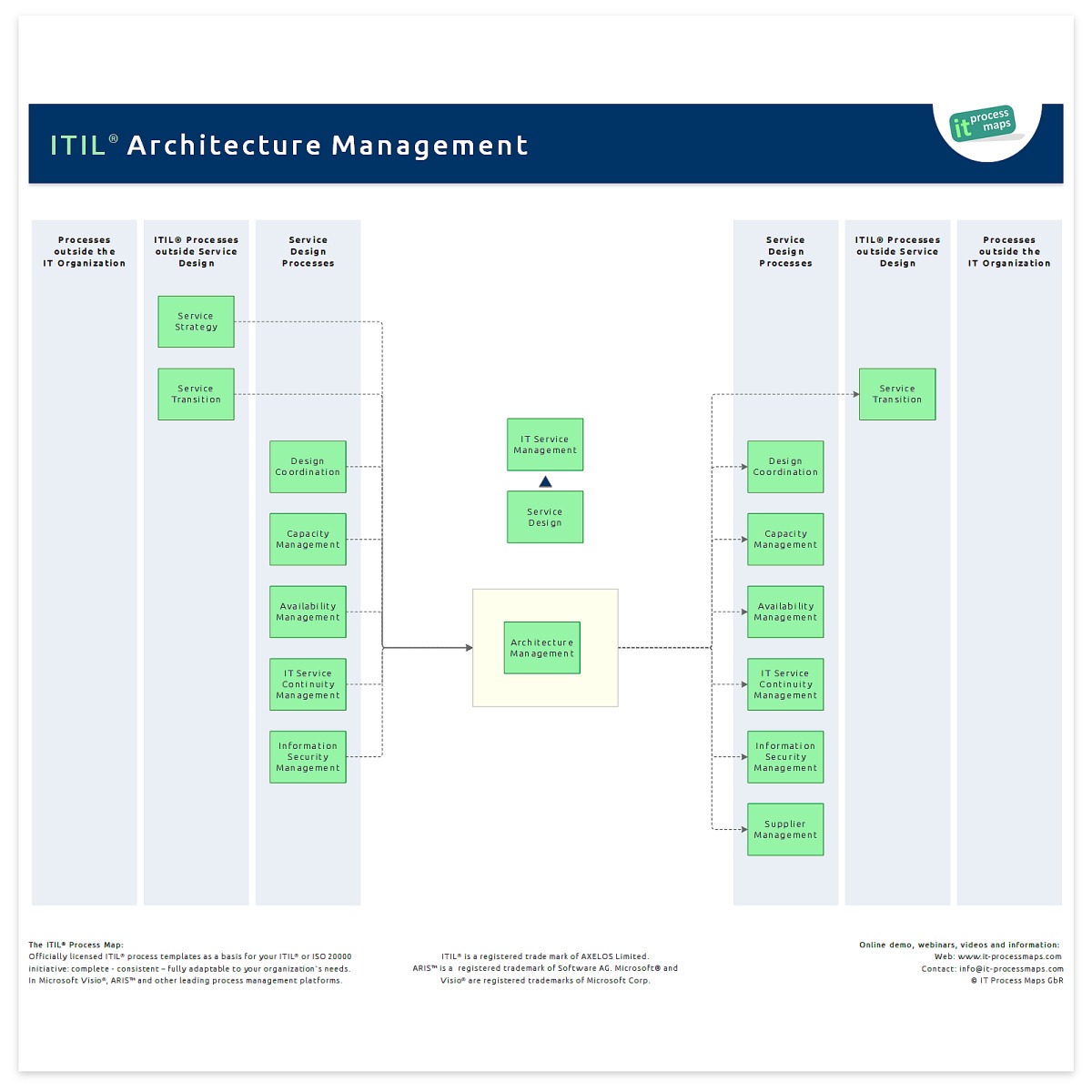
Overview ITIL Architecture Management
|
Use the following links to open the process overview of IT Architecture Management showing the most important interfaces: |
|