IT Architecture Management: Difference between revisions
mNo edit summary |
mNo edit summary |
||
| Line 1: | Line 1: | ||
<seo metakeywords=" | <seo metakeywords="itil architecture management, itil architecture, it architecture management, it architecture management, architecture management process" metadescription="ITIL Architecture Management: ITIL process definition - subprocesses - Additional information on Architecture Management." /> | ||
<imagemap> | <imagemap> | ||
Image:ITIL-Wiki-de-es.jpg|DE - ES - | Image:ITIL-Wiki-de-es.jpg|DE - ES - ITIL Architecture Management|100px | ||
rect 0 0 50 30 [https://wiki.de.it-processmaps.com/index.php/IT_Architecture_Management diese Seite auf Deutsch] | rect 0 0 50 30 [https://wiki.de.it-processmaps.com/index.php/IT_Architecture_Management diese Seite auf Deutsch] | ||
rect 50 0 100 30 [https://wiki.es.it-processmaps.com/index.php/ITIL_Gestion_de_la_Arquitectura_de_TI esta página en español] | rect 50 0 100 30 [https://wiki.es.it-processmaps.com/index.php/ITIL_Gestion_de_la_Arquitectura_de_TI esta página en español] | ||
| Line 8: | Line 8: | ||
<br style="clear:both;"/> | <br style="clear:both;"/> | ||
== ITIL | == ITIL Architecture Management: Overview == | ||
'''Process Objective''': To define a blueprint for the future development of the technological landscape, taking into account the service strategy and newly available technologies. | '''Process Objective''': To define a blueprint for the future development of the technological landscape, taking into account the service strategy and newly available technologies. | ||
| Line 14: | Line 14: | ||
'''Part of''': [[ITIL V3 Service Design|Service Design]] | '''Part of''': [[ITIL V3 Service Design|Service Design]] | ||
'''Process Owner''': [[IT Architecture Management#Additional Information on IT Architecture Management| | '''Process Owner''': [[IT Architecture Management#Additional Information on IT Architecture Management|Enterprise Architect]] | ||
== | == Architecture Management: Process Definition== | ||
[[Image:It-architecture-management.jpg|thumb= | [[Image:It-architecture-management.jpg|left|thumb|350px|alt=ITIL Architecture Management ITIL|[https://wiki.en.it-processmaps.com/images/pdf/process_overview_it_architecture_management_itilv3.pdf ITIL Architecture Management]]] | ||
Architecture Management was covered within Application Management in ITIL V2. | |||
ITIL V3 provides guidance on IT architecture issues as part of a chapter on "technology-related activities". Having a well-defined architecture blueprint in place is very important for IT organizations, so at IT Process Maps we decided to assign clear responsibilities for managing the [[IT Architecture Management#IT Architecture|IT architecture]], which meant introducing a specific | ITIL V3 provides guidance on IT architecture issues as part of a chapter on "technology-related activities". Having a well-defined architecture blueprint in place is very important for IT organizations, so at IT Process Maps we decided to assign clear responsibilities for managing the [[IT Architecture Management#IT Architecture|IT architecture]], which meant introducing a specific Architecture Management process as part of the [https://en.it-processmaps.com/products/itil-process-map.html ITIL® Process Map V3]. | ||
<br style="clear:both;"/> | <br style="clear:both;"/> | ||
=== Sub-Processes === | === Sub-Processes === | ||
No sub-processes are specified for [[IT Architecture Management| | No sub-processes are specified for [[IT Architecture Management|Architecture Management]] in compliance with ITIL V3. | ||
=== | === ITIL Terms: Architecture Management === | ||
;<span id="Change-Request-to-Enterprise-Architecture">Change Request to Enterprise Architecture</span> | |||
:A request to change or extend the Enterprise Architecture, usually issued from the Service Design process when the introduction or modification of a service is not possible within the constraints of the existing application, infrastructure and information/ data architectures. | |||
;<span id="Enterprise-Architecture">Enterprise Architecture (EA)</span> | |||
:An Enterprise Architecture (EA) is a description of the essential components of a business, including their interrelationships. In most cases, an EA covers the following domains: Business, Information, Applications and Technology. | |||
;<span id="Application-Framework">Application Framework</span> | |||
:Application Frameworks aim to promote the re-use of components and the standardizing of technologies on which applications are based. | |||
:For this reason, they have to be planned and managed separately from software development projects – but must be carefully aligned with the needs of software developers. | |||
:Application Frameworks define classes of applications, typically with common non-functional requirements. | |||
== | == Additional Information on Architecture Management == | ||
==== ITIL Roles ==== | |||
; | ;Enterprise Architect - Process Owner | ||
: | :The Enterprise Architect is responsible for maintaining the Enterprise Architecture (EA), a description of the essential components of a business, including their interrelationships. | ||
:Bigger organizations may opt to introduce specialist EA roles like Business Architect, Application Architect, Information Architect, or Infrastructure Architect. | |||
== | == Downloads == | ||
==== Overview ITIL Architecture Management ==== | |||
{| | |||
| valign="top" | | |||
Use the following links to open the process overview of IT Architecture Management showing the most important interfaces: | |||
* [[Media:It-architecture-management.jpg|IT Architecture Management (.JPG)]] | |||
* [https://wiki.en.it-processmaps.com/images/pdf/process_overview_it_architecture_management_itilv3.pdf ITIL Architecture Management (.PDF)]'' | |||
| valign="top" | | |||
[[Image:It-architecture-management.jpg|thumb|150px|left|none|alt=ITIL Architecture Management|ITIL Architecture Management at a glance]] | |||
|- | |||
|} | |||
<!-- This page is assigned to the following categories: --> | <!-- This page is assigned to the following categories: --> | ||
[[Category:ITIL V3]][[Category:ITIL process]][[Category:Service Design| | [[Category:ITIL V3]][[Category:ITIL process]][[Category:Service Design|Architecture Management]][[Category:Architecture Management|!]] | ||
<!-- --- --> | <!-- --- --> | ||
Revision as of 14:59, 26 August 2011
<seo metakeywords="itil architecture management, itil architecture, it architecture management, it architecture management, architecture management process" metadescription="ITIL Architecture Management: ITIL process definition - subprocesses - Additional information on Architecture Management." />

ITIL Architecture Management: Overview
Process Objective: To define a blueprint for the future development of the technological landscape, taking into account the service strategy and newly available technologies.
Part of: Service Design
Process Owner: Enterprise Architect
Architecture Management: Process Definition

Architecture Management was covered within Application Management in ITIL V2.
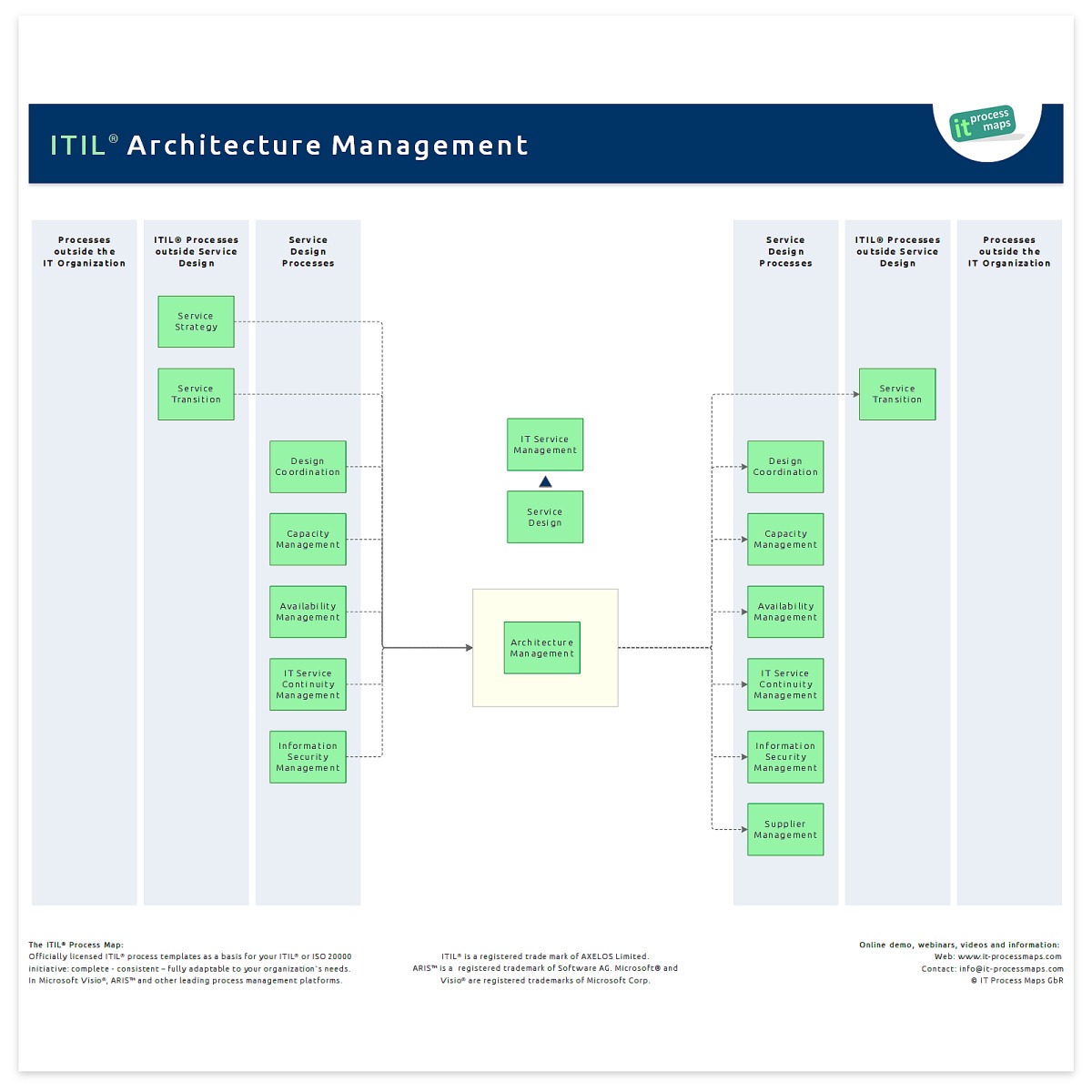
ITIL V3 provides guidance on IT architecture issues as part of a chapter on "technology-related activities". Having a well-defined architecture blueprint in place is very important for IT organizations, so at IT Process Maps we decided to assign clear responsibilities for managing the IT architecture, which meant introducing a specific Architecture Management process as part of the ITIL® Process Map V3.
Sub-Processes
No sub-processes are specified for Architecture Management in compliance with ITIL V3.
ITIL Terms: Architecture Management
- Change Request to Enterprise Architecture
- A request to change or extend the Enterprise Architecture, usually issued from the Service Design process when the introduction or modification of a service is not possible within the constraints of the existing application, infrastructure and information/ data architectures.
- Enterprise Architecture (EA)
- An Enterprise Architecture (EA) is a description of the essential components of a business, including their interrelationships. In most cases, an EA covers the following domains: Business, Information, Applications and Technology.
- Application Framework
- Application Frameworks aim to promote the re-use of components and the standardizing of technologies on which applications are based.
- For this reason, they have to be planned and managed separately from software development projects – but must be carefully aligned with the needs of software developers.
- Application Frameworks define classes of applications, typically with common non-functional requirements.
Additional Information on Architecture Management
ITIL Roles
- Enterprise Architect - Process Owner
- The Enterprise Architect is responsible for maintaining the Enterprise Architecture (EA), a description of the essential components of a business, including their interrelationships.
- Bigger organizations may opt to introduce specialist EA roles like Business Architect, Application Architect, Information Architect, or Infrastructure Architect.
Downloads
Overview ITIL Architecture Management
|
Use the following links to open the process overview of IT Architecture Management showing the most important interfaces: |
|